#1 · Ingo Althofer
3 Apr 2013
A question, also to the strong players:
How big is in your opinions the first-player
advantage in 8x8 Breakthrough?
Or is it a disadvantage to move first?
ingo.
 Little GolemMake your next move.
Public forum discussion.
3 Apr 2013
A question, also to the strong players:
How big is in your opinions the first-player
advantage in 8x8 Breakthrough?
Or is it a disadvantage to move first?
ingo.
3 Apr 2013
I know that you specifically asked about 8x8, but I just want to add that it seems that most solved sizes (with a height more than 2) has player 2 winning.
3 Apr 2013
where can I find detailed data on that?
Ingo.
3 Apr 2013
@Ingo #1: I recall a similar discussion in the past but I can't seem to find it in the forum now. But I remember Ray saying that on 8x8 he believes that the first player has an advantage.
@Thnikkaman, Ingo #2: "I" report a win for Black on 5x5. Not sure if 6x6 is within my grasp.
3 Apr 2013
I have put oracles in java for 3x7 and 5x5 here.
3 Apr 2013
Here is a related discussion.
3 Apr 2013
This was discussed in the breakthrough forum "strategy". I still believe the first move is an advantage in 8x8 :)
3 Apr 2013
@hallabda: Do you still feel that theory points to a second player win in 8x8? I agree that it is hard to ignore all those other results!
3 Apr 2013
I don't really know about theory. But as a player I'm still inclined to believe that 8x8 is a second player win (which doesn't even mean that I have a higher success rate as Black than as White).
3 Apr 2013
One quick follow-up on my "not sure if 6x6 is within reach" comment. After a few tests I think it's fairly clear that Wanderer is not even close to having anything to say about the status of 6x6.
3 Apr 2013
@wanderer_c: Perhaps it can focus on lower targets, like 4x6, 3x7, 6x4, 7x3
4 Apr 2013
In the generalized version, do you always start with pawns on your two back rows ?
9 Apr 2013
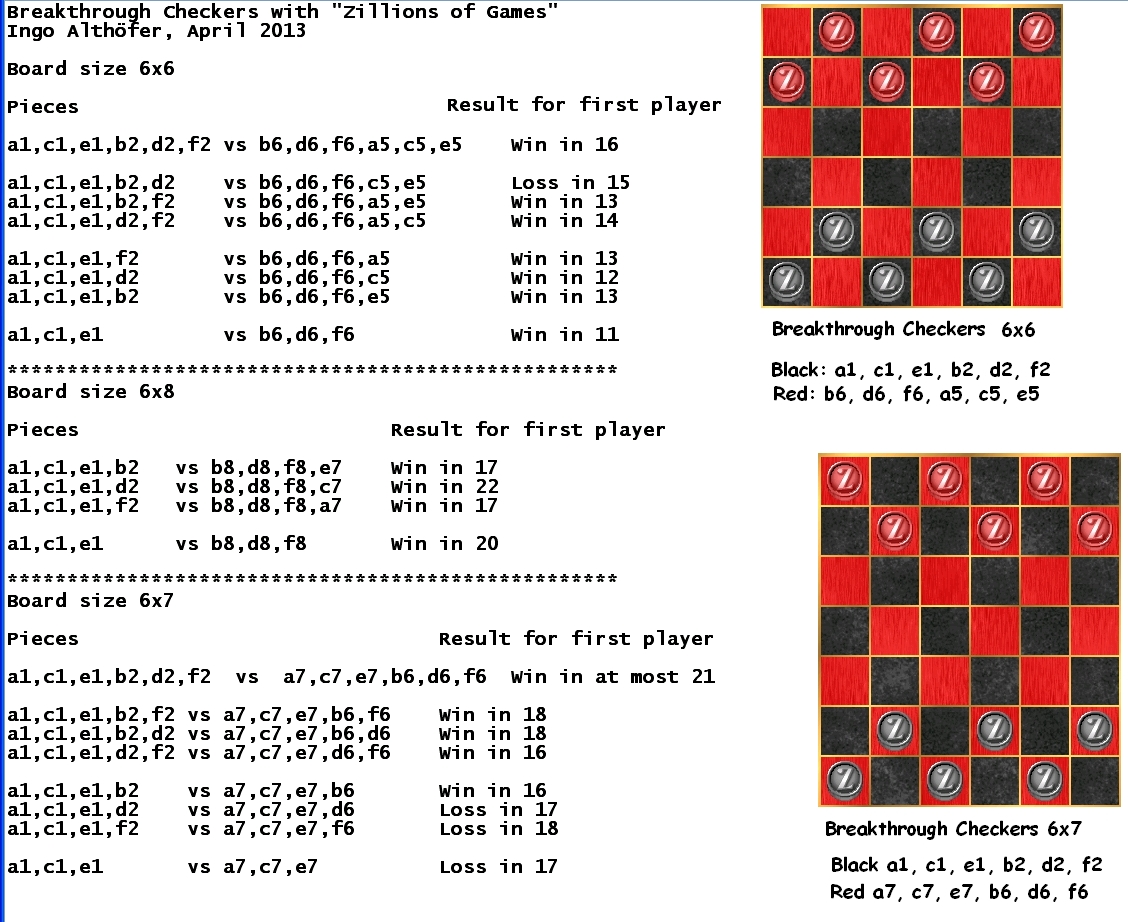
\*\*\* Results of an experiment ***
I own "Zillions of Games", under which
Breakthrough can be run in an iterative-deepening
alpha-beta game tree search.
I wanted to collect some computer results on a
possible first-player advantage in Breakthrough.
Breakthrough itself is too large to be "fully
computed" by Zillions. So, instead I look at a
similar game on small boards. I took "Checkers"
(british/U.S. rules) and simplified the rules in
the spirit of Brakthrough: Winner is the player
who brings one of his pieces to the opponent's
back rank.
On small boards (sizes 6x6, 6x7, 6x8) I looked
at several symmetrical starting positions with
3 or 4 or 5 or 6 pieces for each player.
Amongst alltogether 20 positions the first player
had a win in 16 positions. Remarkably, three of
the four losses for the first player are on the
board with 7 rows.
Conclusion: In these positions the first player
has better chances to win.
For some more details look at
this site.
Ingo.
9 May 2013
Very interesting, thanks for posting.
21 May 2013
Looking at the most recent stats on igGameCenter, Breakthrough has an incredibly small difference between first- and second-player wins.
http://www.iggamecenter.com/stats/game40.html
As of this post, it is 532 wins 1st player, 530 wins 2nd player.
Does anyone have any more stats on this game?
21 May 2013
It would be interesting to know the 'real' first player win percentage. To get that you should only count games where players are more or less equal in strength. If you count each game, including big rating differences, loss on time etc. then those numbers don't say much.
About Ingo's analyzis: It's interesting, but imho it's a different game, you can't compare the results to breakthrough.
22 May 2013
I disagree that "those numbers don't say much". Games where players aren't equal in strength would just dilute the data, not skew it.
22 May 2013
For the first rated players here are the stats of:
Player name.....Games won by 1st player....Games won by 2nd player
ray_garrison....482........................483
halladba........139........................129
stop_sign........73.........................61
mojo_rising.....126........................122
kyle_douglas....337........................312
david_scott......76.........................81
mojmir_hanes....200........................173
vic..............56.........................55
Sorry for presentation, I hate textile pseudo-implementation with no |table| nor pre.. code.
22 May 2013
A little more work with grep shows that for Ray Garrison it breaks down as:
- when Ray starts with he wins 429 games and loses 47, for a total of 476 whereas
- when Ray is Black, first wins 53 games and Ray 436, for a total of 489...
The ratios for Ray of wins as white and as black are respectively of 90.13% and 89.16% !
22 May 2013
For halladba, these figures are:
White 105/134 = 78.36%, Black 100/134 = 74.63%
22 May 2013
Sorry, as MarleysGhost pointed out, there are some typos:
White starts and Black is second player, so you should read:
"when Ray starts as White, he wins..." and then "... when Ray is black, first player (White) wins 53 games...".
22 May 2013
I recently ran a self-test with Wanderer. Playing 500 games at 10 secs per move White won 262 games, = 52.4%.
22 May 2013
My statistics are rusty, but neither the difference between 105/134 and 100/134 nor between 262/500 and 1/2 looks significant. Could someone whose confidence is greater than mine estimate the confidence with which we can say they're different?
22 May 2013
I'm not a statistician either, but I think it depends what your philosophy is:
- if you want to have a test at confidence level 95% to assert that p>1/2 that White wins, then the sampling is not big enough,
- but if you are a Bayesian trying to estimate p based on the sampling you have, then you will get a p>0.5
Any real statistician out here?
22 May 2013
Further thoughts on the problem, my two-cents is that the game is either a first-player win or a second-player win with probability 1 (see http://www.lamsade.dauphine.fr/~cazenave/papers/solving.pdf), but the tree is way too big for humans beings to approach it. The authors of the paper conclude PN2 and PPN2 search had some trouble with zugzwang situations common in breakthrough, because of lack of race patterns, despite successfully solving 6x5 as a second player win...
So other factors like being pleased to start may have more impact on the outcome of the game than the actual tree...
22 May 2013
What I have experienced is that in a couple games versus kingofthebesl, is that a position that is often achievable, favors black. In games:
http://www.littlegolem.net/jsp/game/game.jsp?gid=1346314&nmove=44
http://www.littlegolem.net/jsp/game/game.jsp?gid=1310719&nmove=44
I have wondered if this position is a zugzwang. In the first game, white tries c1-b2 but it fails. In the other b1-b2 fails. White trading off does not help, because it gives black an extra piece further forward. So, my conclusion is that if you are black, trying to achieve this position seems to work.
13 Dec 2013
You are right, Kyle. And those of us who have the feeling that Black is winning might have this nice zugzwang in mind. But this similar position:
http://www.littlegolem.net/jsp/game/game.jsp?gid=1596956&nmove=40
is a race and therefore a win for White.
To be even more caricatural. Let's include the moves 41.h1-g2 42.g5-g4, so the position is symmetrical.
Now 43.b3-a4 is definitely a race.
White wants to exchange on c6, play a4-b5, reach the sixth rank with that pawn and make a winning pawn sacrifice in the center to obtain a second pawn in the sixth rank.
The question is can Black always build the straight wall:
http://www.littlegolem.net/jsp/game/game.jsp?gid=1346314&nmove=44
or can White destabilize the wall:
http://www.littlegolem.net/jsp/game/game.jsp?gid=1596956&nmove=40
?
If one wants to have a good intuition about which player is winning, one could tune the rules:
- exchanging is no longer allowed (but taking a non sufficiently protected pawn still is)
- Black wins if he forms the straight wall
- White wins on move 45 otherwise.
Indeed the only other way (in addition to the destabilized wall) for White to prevent the straight wall (without exchanges) is to get the "missing tooth in the center" position which is also a win for White.
And we "know" that exchanging in the enemy's camp is bad.
14 Dec 2013
Thanks for bumping this interesting threat, how long do you think we need before getting the answer? Will breakthrough be dead then?
[game;id:1596956;move:40;title:White winning race]
[game;id:1346314;move:44;title:Black Hadrian\'s Wall]
14 Dec 2013
white pomegranate wins...
http://www.littlegolem.net/jsp/game/game.jsp?gid=1346314&nmove=44
45. c4xd5 ....
14 Dec 2013
46.c6xd5 is a win for Black.
14 Dec 2013
Taking symmetry and transpositions into account, table-basing the simplified game I defined, should be already possible.
14 Dec 2013
black, played in a way which, if continued, 45. c4xd5 move .... wins.
this game is incorrect, when the white moves on to lose, I want to say.
14 Dec 2013
So, please continue after 46.c6xd5.
We are not talking of the game, we are talking about this position in general.
14 Dec 2013
I think we are not properly understanding gardiyan. I suspect he is using an automatic translator that could probably use a little work. E.g., "pomegranate"?!
14 Dec 2013
yes .. :0)
'pomegranate' sentence was incorrect.
I use automatic translator.
I don't know English.
10 Jan 2014
This is a nice try by Gardiyan to cope with Black Hadrian's wall:
http://www.littlegolem.net/jsp/game/game.jsp?gid=1605553&nmove=35
The point of my refutation is that on 43.a4-a5 (which is a better try) 44.b4-b3! 45.a5-b6 46.a6-a5!! 47.c4-c5 48.f8-e7 and Black wins.
It is crucial not to move the a6 pawn until the White pawn gets to b6, and blocks the second White pawn on c5.
Since I am basically alone in trying to galvanize the breakthrough forum, I assume that few are interested in such things.
Maybe I am wrong. Halladba, your recent connection, though you have 0 ongoing game, was that to read the forum, or are you checking if the championship finally starts.
Do not tell me you get off the championship!
"You may say I'm a breakthrough theorist, but [hopefully] I'm not the only one." Am I?
10 Jan 2014
I don't consider myself a Breakthrough theorist, but I like working with Wanderer to try to answer some of these questions and better understand the game.
Wanderer doesn't like Gardiyan's sacrifice but rather thinks that earlier white should shift to the other side of the board with 37. g3-g4 where he simply follows 38. g7-g6 with 39. h1-g2 and thinks he is doing fine. Is he not seeing trouble on the other side of the board?
10 Jan 2014
At the time of Gardiyan/Basat's sacrifice, it is already too late.
I will play a5-b4 anyway with the same consequences (the extra white pawn in b3 will not help).
Well, on 37.g3-g4 38.g7-g6 39.h1-g2, the simplest win for Black is to play 40.g7-h6 41.g2-g3 42.h6-g5 and the well known zugzwang occurs: for instance 43.c2-b3 44.b6-a5 0-1
Instead of 40.g7-h6, the same plan with b6-a5-b4 should also win.
11 Jan 2014
http://www.littlegolem.net/jsp/game/game.jsp?gid=1605553&nmove=35
(35.b3-b4)...white high chance of winning is the way to continue.
11 Jan 2014
Interesting! So it seems you were already lost after 35. b3-a4. In which case: (1) Can you really survive after 35. b3-b4? (early experiments look promising for White) but if not, (2) How far back do we have to go to find a saving move for White?!
12 Jan 2014
After 35.b3-b4 36.b7-a6 37.c2-b3 38.a6-b5 and Black wins. It soon reaches the known zugzwang position.
16 Feb 2014
I am interested in the results, but am not strong enough or devoted enough to contribute meaningfully.
3 Apr 2014
From experimenting with my program Luffy, it seems that it plays stronger with white.
Since the opening seems to resolve around the control of center squares on lines 4 and 5, it would seem logical that playing first is an advantage.
3 Apr 2014
white development is advantages. but white more encounters with the zugzwang position.
7 Apr 2014
I think the game is a second player win with optimal play reaching zugzwang.
Does anyone know some breakthrough dimensions where player 1 wins but not in 1 move?
9 Apr 2014
My last encounter with wanderer helped me relativize the ease that Black might have to force the Black Hadrian's wall.
Consider the following diagram:
[game;id:1626571;move:41;title:Are 42.h6-g5 and 42.a6-b5 both winning for Black?]
Convinced that I was totally winning, I rushed and played 42.a6-b5? thinking that I was about to attend computer's standard desperation moves.
I was immediately punished: 43.c4xb5! 44.c6xb5 45.c3-c4!!
[game;id:1626571;move:45;title:Although Black seems a tempo ahead in the queenside, the extra defensive pawn in d2 which protects the c3 square is decisive.]
Compare the useless pawn in h6 to the pawn in d2.
Black is lost.
Instead, 42.h6-g5 was winning.
For example, 43.c4xb5 44.c6xb5 45.c3-c4 46.e5xf4 47.e3xf4 48.g5xf4 49.c4xd5 50.e6xd5 51.e4xd5 52.f4-g3 53.d5-e6 54.f6-g5 55.d4-d5 56.b8-b7! 0-1 (or 53.d5-c6 54.f6-g5 55.d4-d5 56.f8-f7! 0-1)
The conclusion seems to be that the attempt to keep a central defensive pawn does not quite work.
What about other attempts to thwart the Black's Hadrian wall?
[game;id:1626571;move:38;title:Is 39.g4-g5 a real danger for Black?]
10 Apr 2014
Rather than risk jumping to conclusions, would you kindly adjust the coordinates on your sample variation? I'd like to see what Wanderer thinks about it all. Thanks!
10 Apr 2014
*good attack, congratulations.*
10 Apr 2014
Soory, you should read 43.c4x**d**5 44.c6x**d**5
17 Apr 2018
Now a few years later I have re-run the analysis for the current top players, as arr28 and I were wondering about this issue. The results are (first number is winning percentage with White, second with Black):
wanderer_bot: 81.22% / 76.39% (533 games)
Ray Garrison: 89.92% / 89.18% (985 games)
luffy_bot: 68.75% / 66.04% (117 games)
edbonnet: 85.11% / 84.51% (283 games)
halladba: 78.77% / 72.79% (293 games)
David Scott: 76.07% / 80.62% (246 games)
michelwav: 80.95% / 74.42% (85 games)
Mojmir Hanes: 83.59% / 77.66% (392 games)
ahhmet: 70.05% / 68.98% (374 games)
basat: 72.32% / 73.37% (361 games)
Stop_Sign: 69.64% / 65.56% (319 games)
MojoRising: 75.44% / 70.95% (350 games)
isketzo067: 59.29% / 66.07% (225 games)
busybee: 74.42% / 59.09% (87 games)
antony: 71.79% / 57.14% (81 games)
smilingface: 59.38% / 58.89% (186 games)
ypercube: 67.25% / 72.08% (595 games)
Marius Halsor: 57.89% / 58.94% (303 games)
bennok: 62.62% / 68.87% (213 games)
Tim Shih: 80.39% / 74.24% (117 games)
arr28: 80.65% / 91.67% (67 games)
Reiner Martin: 60.14% / 60.57% (555 games)